
PHSD

Parton-Hadron-String Dynamics

A microscopic off-shell transport approach for the description of strongly interacting hadronic and partonic matter in and out of equilibrium.

About PHSD

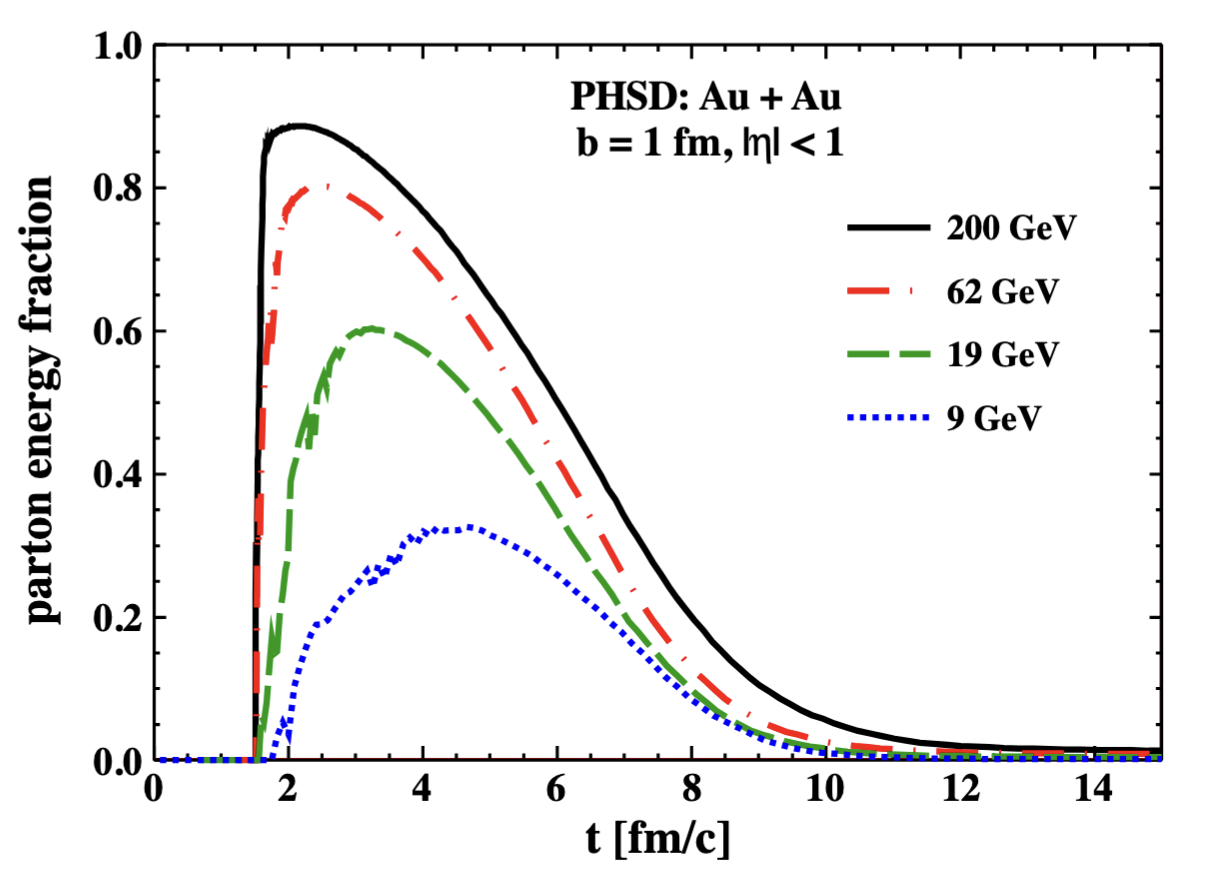
The Parton-Hadron-String Dynamics (PHSD) is a microscopic off-shell transport approach for the description of strongly interacting hadronic and partonic matter in and out-of-equilibrium. It is based on the solution of Kadanoff-Baym equations in first-order gradient expansion in phase space, allowing a causal description of the time evolution of nonperturbative interacting systems. PHSD consistently describes the full evolution of a relativistic heavy-ion collision from the initial hard scatterings and string formation through the dynamical deconfinement phase transition to the quark-gluon plasma, followed by hadronization and subsequent hadronic interactions. The PHSD has been developed by the Giessen/Frankfurt groups on the basis of the Hadron-String Dynamics transport approach (HSD).
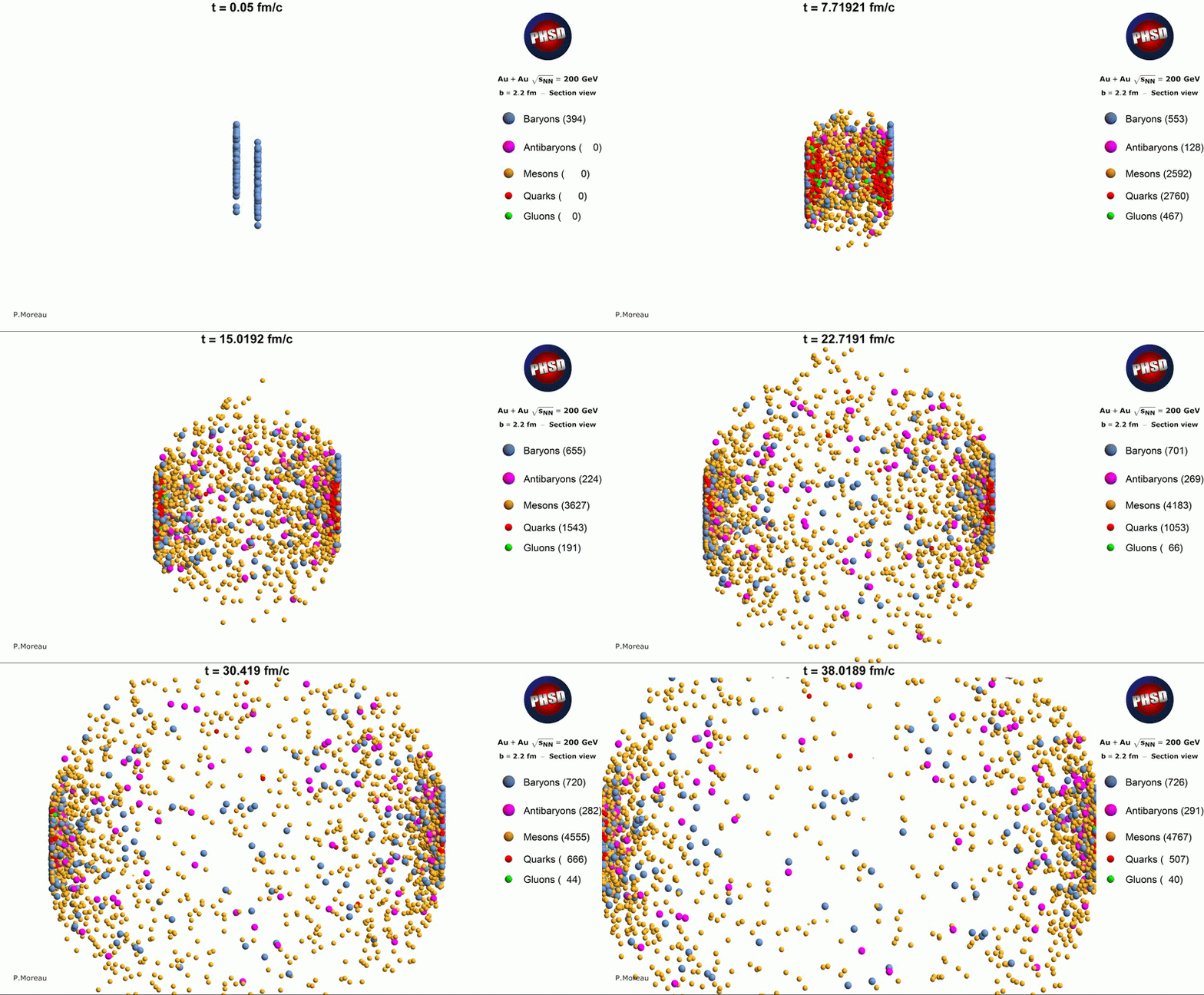
Au+Au at 200 GeV
Au+Au at 200 GeV
Click to download the full-size video

In PHSD the transition from partonic (quarks and gluons) to hadronic degrees of freedom is described by covariant transition rates for quark-antiquark fusion to mesonic resonances or three quarks (antiquarks) to baryonic states, i.e. by a dynamical hadronization obeying flavor current-conservation, color neutrality and energy-momentum conservation. The two-particle correlations resulting from finite parton spectral widths are treated dynamically by generalized off-shell Cassing-Juchem transport equations that go beyond mean-field or Boltzmann approximations.

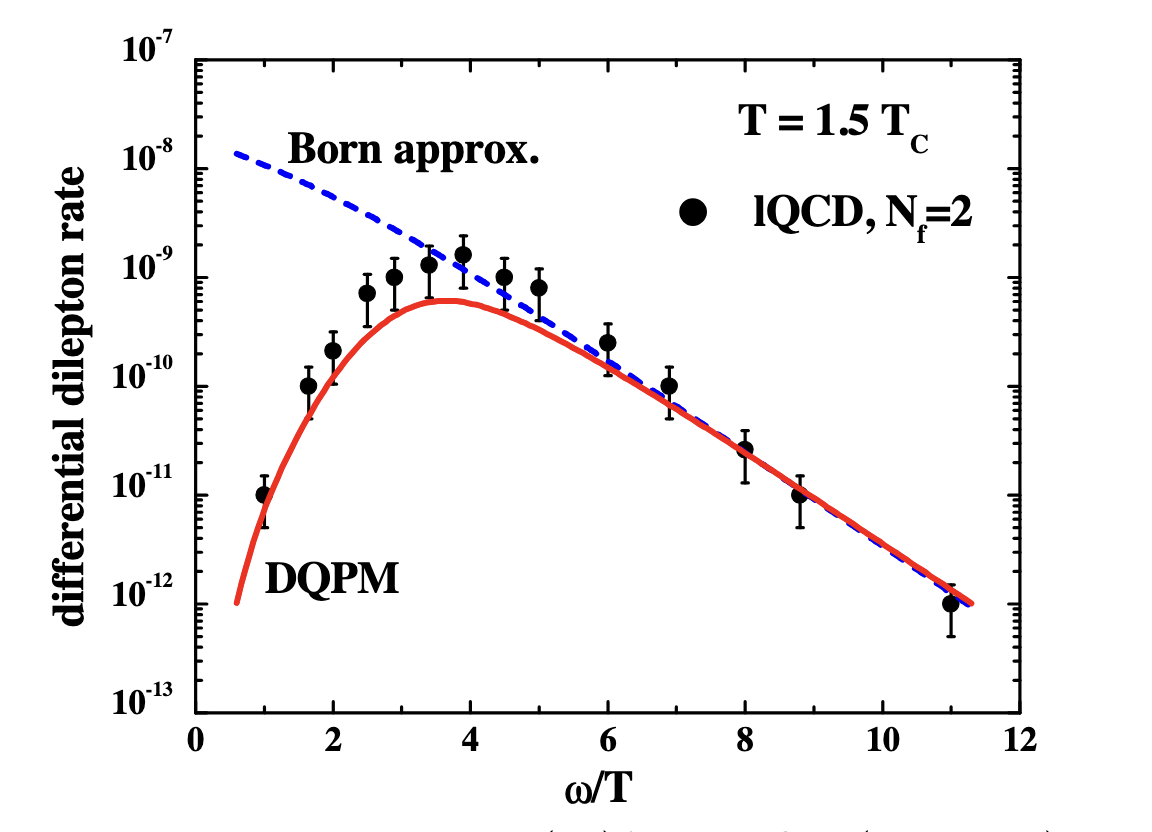
The transport-theoretical description of quarks and gluons in PHSD is based on the Dynamical Quasi-Particle Model (DQPM), constructed to reproduce lattice-QCD results for the quark-gluon plasma in thermodynamic equilibrium. DQPM provides mean fields and effective two-body interactions for gluons and quarks. Close to the phase transition, dynamically massive quarks and antiquarks form resonant pre-hadronic color-dipole states (q-qbar or qqq) with high invariant mass that sequentially decay to meson and baryon octets. The resulting hadronization increases total entropy and thus remains consistent with the second law of thermodynamics.

Click to download the full-size video

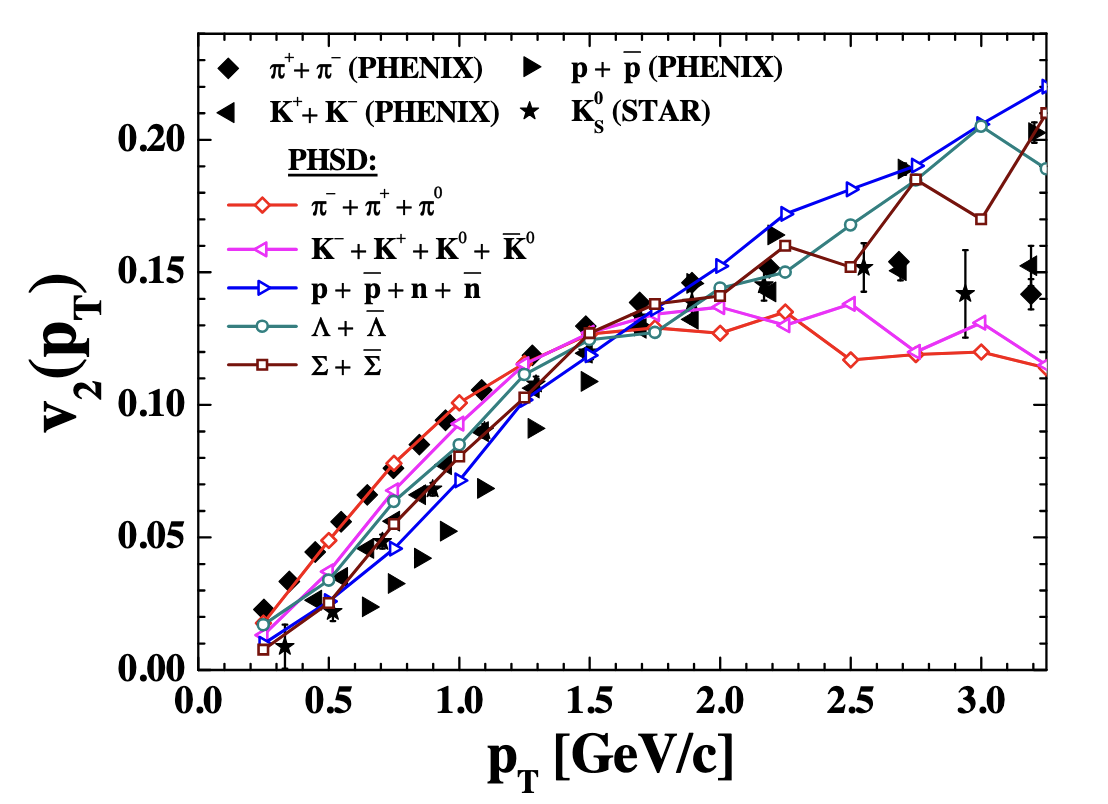
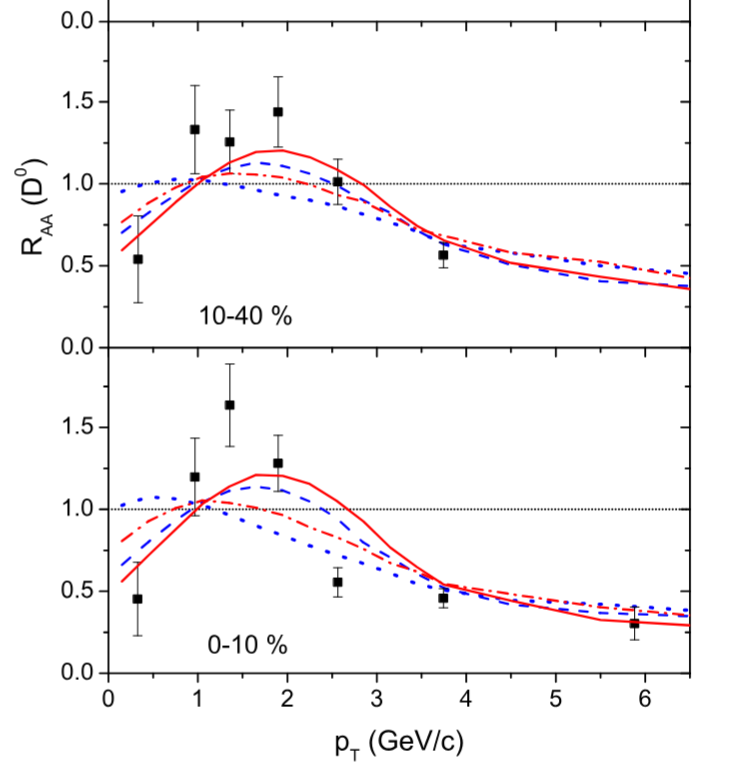
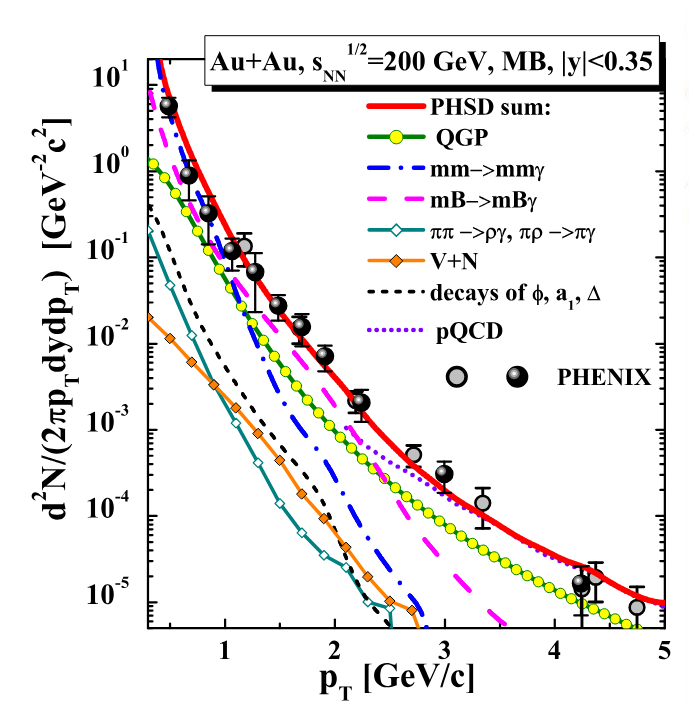
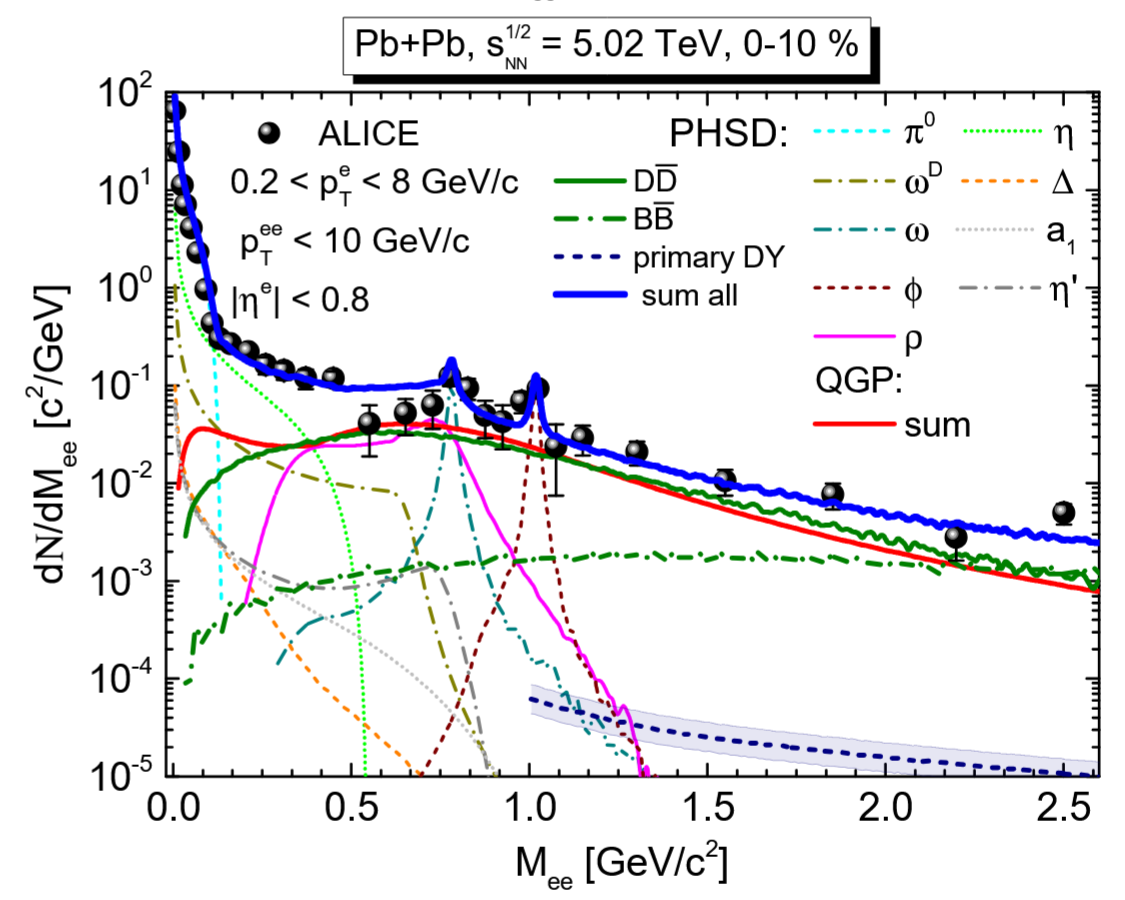
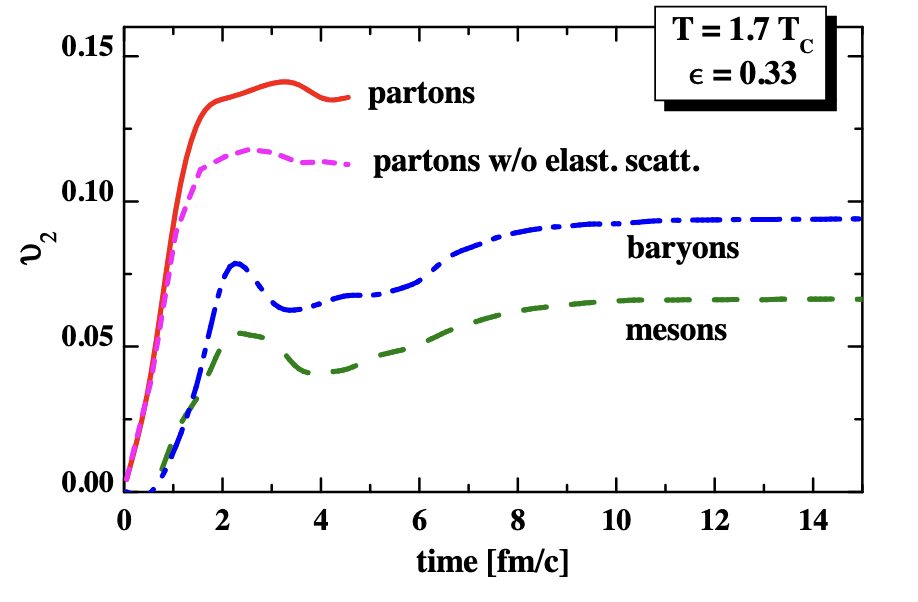
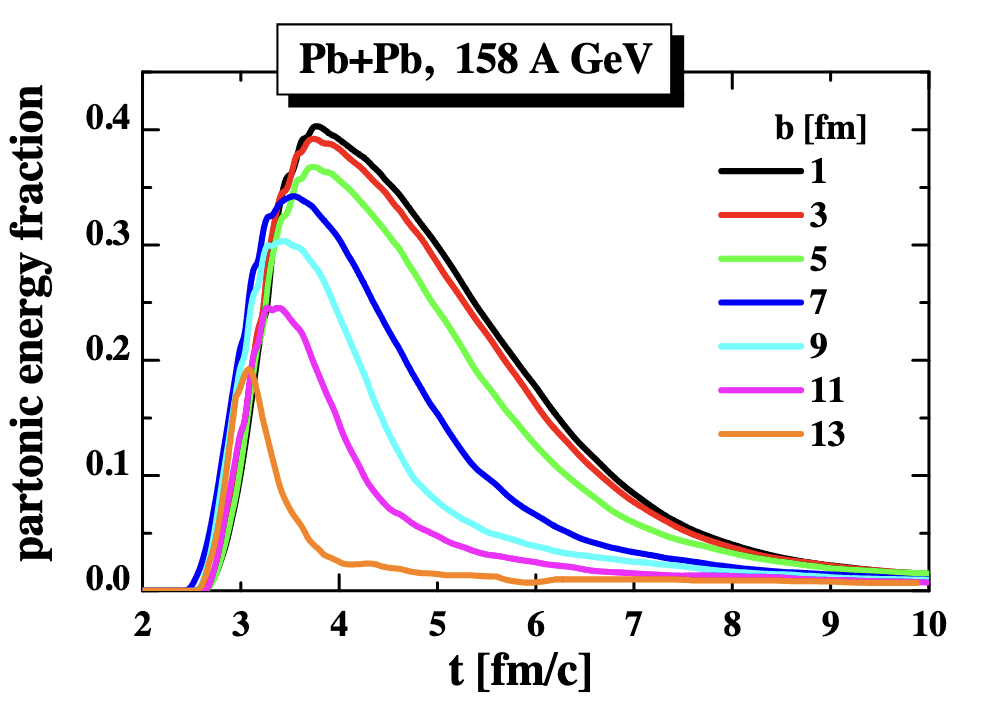
The PHSD approach has been applied to nucleus-nucleus collisions from low SPS to LHC energies to explore space-time regions of partonic matter. It provides a consistent description of bulk heavy-ion observables - rapidity spectra, transverse-mass distributions, and azimuthal asymmetries (v1, v2, v3, v4) - and has been successfully used for dilepton analyses from hadronic and partonic sources.
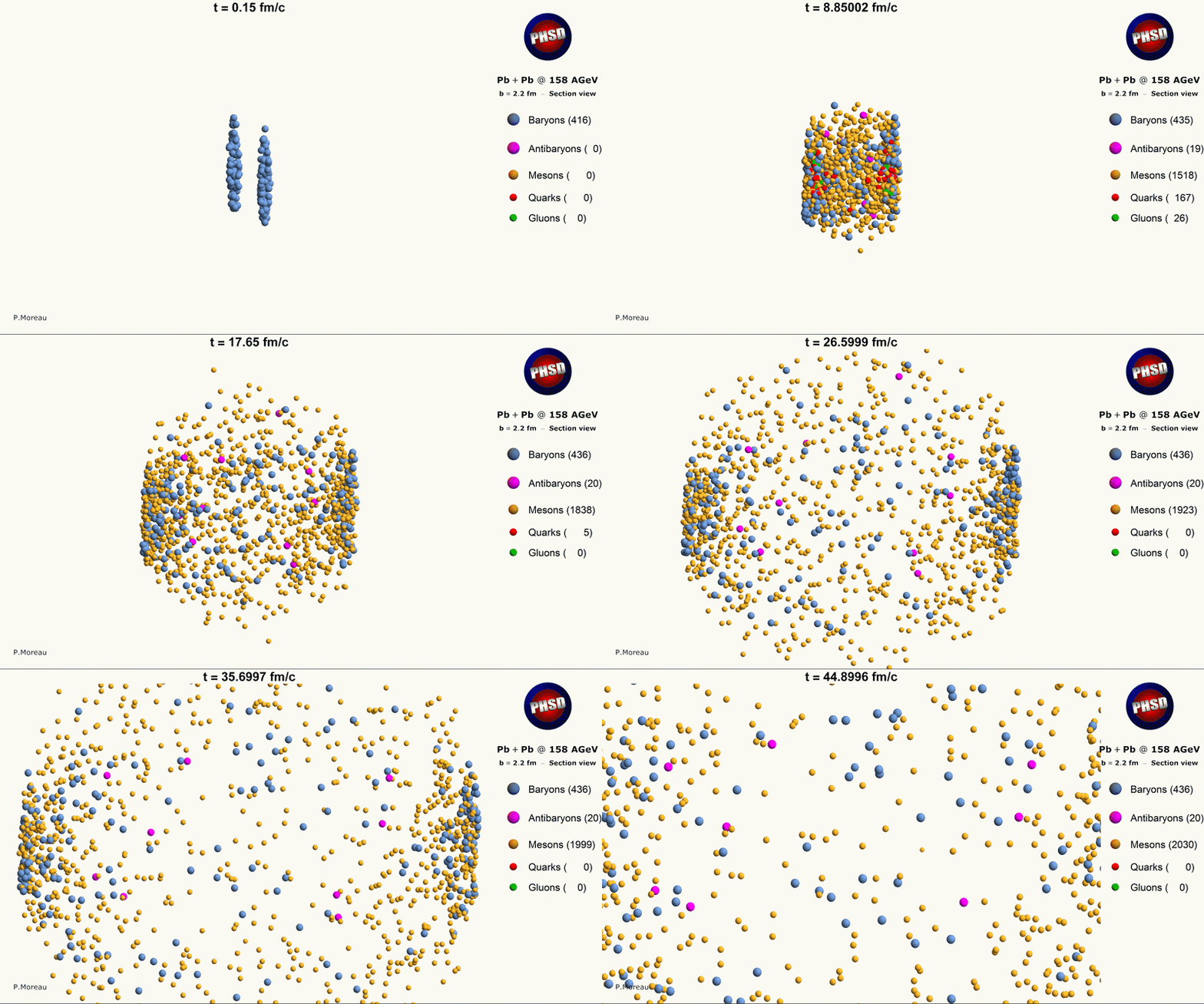
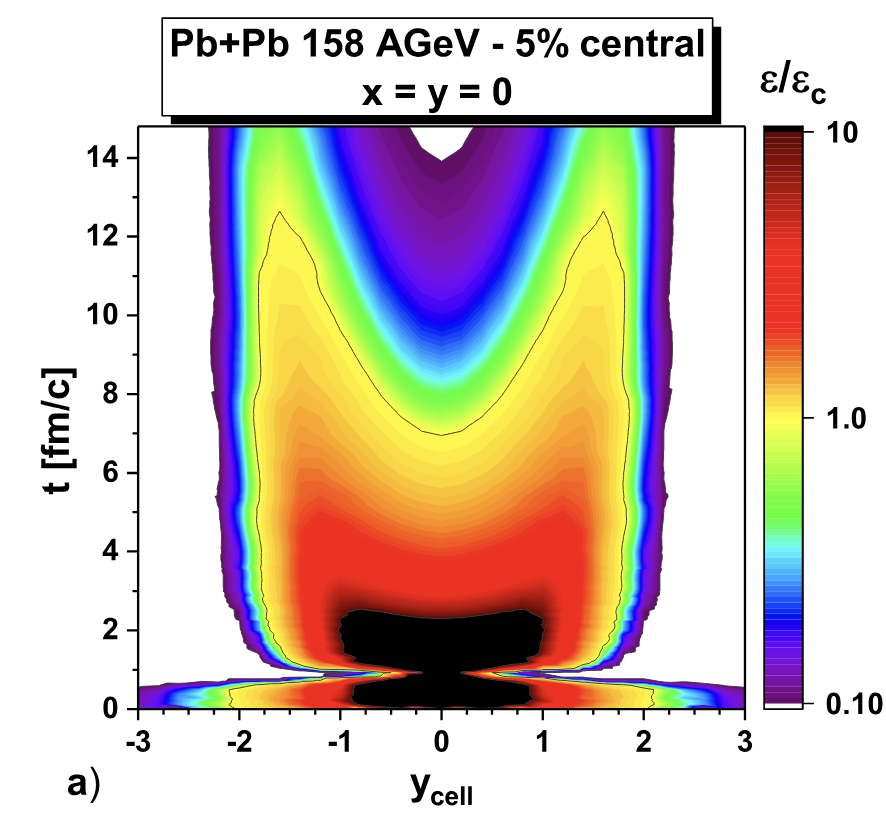
Pb+Pb at 158 AGeV
Pb+Pb at 158 AGeV

Equilibrium properties of QGP were also studied with PHSD in a finite box with periodic boundary conditions at fixed temperature T. The ratio of shear viscosity to entropy density shows a minimum close to Tc = 160 MeV and approaches the perturbative QCD limit at higher temperatures, in line with lattice-QCD results. This indicates a strongly interacting liquid-like QGP rather than a weakly interacting gas of partons.
Publications

How to cite PHSD and selected related publications.

How to cite PHSD

Parton transport and hadronization from the dynamical quasiparticle point of view

W. Cassing and E. L. Bratkovskaya - Phys. Rev. C 78 (2008) 034919


Parton-Hadron-String Dynamics: an off-shell transport approach for relativistic energies

W. Cassing and E. L. Bratkovskaya - Nucl. Phys. A 831 (2009) 215-242

From Kadanoff-Baym dynamics to off-shell parton transport

W. Cassing - Eur. Phys. J. ST 168 (2009) 3-87

Parton-Hadron-String Dynamics at Relativistic Collider Energies

E. L. Bratkovskaya, W. Cassing, V. P. Konchakovski, O. Linnyk - Nucl. Phys. A 856 (2011) 162-182

(Electro-)Magnetic field evolution in relativistic heavy-ion collisions

V. Voronyuk, V. D. Toneev, W. Cassing, E. Bratkovskaya, V. P. Konchakovski - Phys. Rev. C 83 (2011) 054911

Rise of azimuthal anisotropies as a signature of the Quark-Gluon-Plasma in relativistic heavy-ion collisions

V. P. Konchakovski, E. L. Bratkovskaya, W. Cassing, V. D. Toneev, V. Voronyuk - Phys. Rev. C 85 (2012) 011902

Shear and bulk viscosities of strongly-interacting infinite parton-hadron matter within the PHSD transport approach

V. Ozvenchuk, O. Linnyk, M. I. Gorenstein, E. L. Bratkovskaya, W. Cassing - Phys. Rev. C 87 (2013) 064903

Tomography of the Quark-Gluon-Plasma by Charm Quarks

T. Song, H. Berrehrah, D. Cabrera, J. M. Torres-Rincon, L. Tolos, W. Cassing, E. Bratkovskaya - Phys. Rev. C 92 (2015) 014910

Chiral symmetry restoration versus deconfinement in heavy-ion collisions at high baryon density

W. Cassing, A. Palmese, E. Seifert, T. Steinert, P. Moreau, E. L. Bratkovskaya - Phys. Rev. C 93 (2016) 014902

Chiral symmetry restoration in heavy-ion collisions at intermediate energies

A. Palmese, W. Cassing, P. Moreau, E. L. Bratkovskaya - Phys. Rev. C 94 (2016) 044912

Effective QCD and transport description of dilepton and photon production in heavy-ion collisions and elementary processes

O. Linnyk, E. L. Bratkovskaya, W. Cassing - Prog. Part. Nucl. Phys. 87 (2016) 50-115

Open charm and dileptons from relativistic heavy-ion collisions

T. Song, W. Cassing, P. Moreau, E. Bratkovskaya - Phys. Rev. C 97 (2018) 064907

Baryon-antibaryon annihilation and reproduction in relativistic heavy-ion collisions

E. Seifert, W. Cassing - Phys. Rev. C 97 (2018) 024913

Exploring the partonic phase at finite chemical potential within an extended off-shell transport approach

P. Moreau, O. Soloveva, L. Oliva, T. Song, W. Cassing, E. Bratkovskaya - Phys. Rev. C (2019)

In-medium effects in strangeness production in heavy-ion collisions at (sub)threshold energies

T. Song, L. Tolos, J. Wirth, J. Aichelin, E. Bratkovskaya - Phys. Rev. C 103 (2021) 044901

Transport properties and equation-of-state of hot and dense QGP matter near the critical endpoint in the phenomenological dynamical quasiparticle model

O. Soloveva, J. Aichelin, E. Bratkovskaya - Phys. Rev. D 105 (2022) 054011

Inelastic and elastic parton scattering in the strongly interacting quark-gluon plasma

I. Grishmanovskii, O. Soloveva, T. Song, C. Greiner, E. Bratkovskaya - Phys. Rev. C 109 (2024) 024911

Book

Transport Theories for Strongly-Interacting Systems: Applications to Heavy-Ion Collisions

Wolfgang Cassing - Lecture Notes in Physics 989 (2021)

Talks

Selected PHSD talks with direct slide links.

From hadrons to partons and back

Elena Bratkovskaya - EMMI Nuclear and quark matter seminar, GSI, Darmstadt, Germany, 9 Jul 2014

The QGP dynamics in relativistic heavy-ion collisions

Elena Bratkovskaya - Kruger2014, South Africa, 1-5 Dec 2014

Tomography of the Quark-Gluon-Plasma by Charm Quarks

Elena Bratkovskaya - Heavy Flavor Working Group Meeting, Berkeley Lab, USA, 18-22 Jan 2016

Observables of chiral symmetry restoration in heavy-ion collisions

Alessia Palmese - International School of Nuclear Physics, Erice, Italy, 21 Sep 2016

Electromagnetic emissivity of hot and dense matter

Elena Bratkovskaya - Makutsi, South Africa, 23-28 Nov 2015

Chiral symmetry restoration versus deconfinement in heavy-ion collisions at high baryon density

Elena Bratkovskaya - CPOD 2016, Wroclaw, Poland, 30 May-4 Jun 2016

Processes in collisions of heavy-ions

Pierre Moreau - CBM Students Colloquium, GSI, Darmstadt, Germany, 19 Mar 2017

Electromagnetic emissivity of hot and dense matter: QGP vs charm

Elena Bratkovskaya - 34th Winter Workshop on Nuclear Dynamics, Guadeloupe, 25-31 Mar 2018

Dynamical description of partonic phase at finite chemical potential

Elena Bratkovskaya - NeD-2019, Italy, 16-22 Jun 2019

Exploring the QGP at finite baryon chemical potential in and out of equilibrium

Elena Bratkovskaya - Arizona State University colloquium, 20 Jan 2021

The impact of electromagnetic and vortical fields in relativistic nuclear collisions

Lucia Oliva - Arizona State University colloquium, 27 Jan 2021

Transport coefficients of the dense QGP along the chiral phase transition

Olga Soloveva - Transport meeting, Frankfurt (Zoom), 10 Dec 2020