Publications

Recommended references to cite PHSD, core model papers, and yearly archives on INSPIRE.

How To Cite PHSD

Recommended primary references for PHSD method and implementation.

Parton transport and hadronization from the dynamical quasiparticle point of view

W. Cassing and E. L. Bratkovskaya · Phys. Rev. C 78 (2008) 034919

Show abstract

The hadronization of an expanding partonic fireball is studied within the Parton-Hadron-Strings Dynamics (PHSD) approach which is based on a dynamical quasiparticle model (DQPM) matched to reproduce lattice QCD results in thermodynamic equilibrium. Apart from strong parton interactions the expansion and development of collective flow is driven by strong gradients in the parton mean-fields. An analysis of the elliptic flow v2 demonstrates a linear correlation with the spatial eccentricity epsilon as in case of ideal hydrodynamics. The hadronization occurs by quark-antiquark fusion or 3 quark/3 antiquark recombination which is described by covariant transition rates. Since the dynamical quarks become very massive, the formed resonant pre-hadronic color-dipole states (q-qbar or qqq) are of high invariant mass, too, and sequentially decay to the groundstate meson and baryon octets increasing the total entropy. This solves the entropy problem in hadronization in a natural way. The resulting particle ratios turn out to be in line with those from a grandcanonical partition function at temperature T approximately 170 MeV, rather independent from the initial temperature, and indicate an approximate strangeness equilibration.
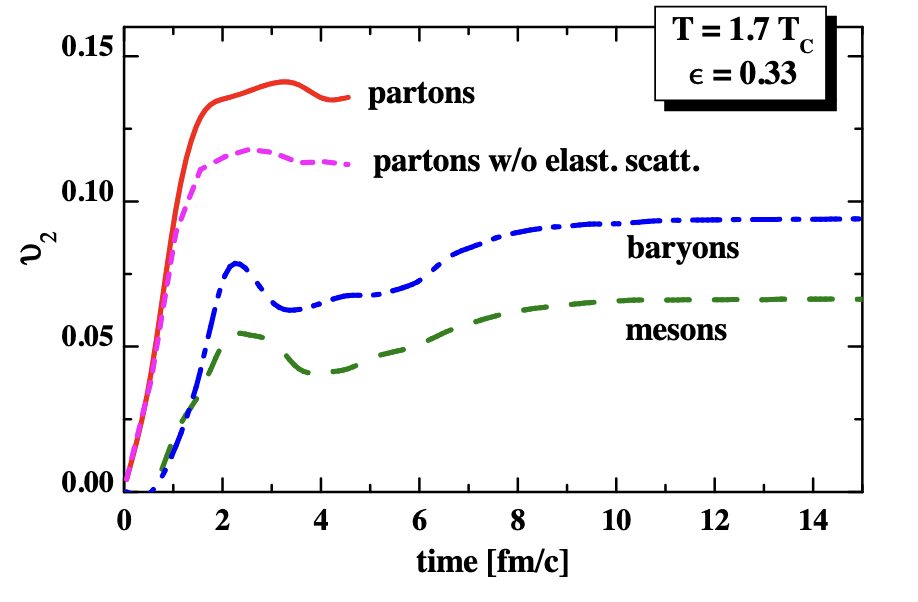
Time evolution of the elliptic flow v2.

Parton-Hadron-String Dynamics: an off-shell transport approach for relativistic energies

W. Cassing and E. L. Bratkovskaya · Nucl. Phys. A 831 (2009) 215-242

Show abstract

The dynamics of partons, hadrons and strings in relativistic nucleus-nucleus collisions is analyzed within the Parton-Hadron-String Dynamics (PHSD) transport approach, which is based on a Dynamical QuasiParticle Model (DQPM) for partons matched to reproduce lattice-QCD results in thermodynamic equilibrium. Scalar- and vector-interaction densities are extracted from the DQPM as well as effective scalar- and vector-mean fields for the partons. The transition from partonic to hadronic degrees of freedom is described by covariant transition rates for the fusion of quark-antiquark pairs or three quarks (antiquarks), obeying flavor current-conservation, color neutrality and energy-momentum conservation. Since the dynamical quarks and antiquarks become very massive close to the phase transition, the formed resonant pre-hadronic color-dipole states (q-qbar or qqq) are of high invariant mass, too, and sequentially decay to the groundstate meson and baryon octets increasing the total entropy. The PHSD approach is applied to nucleus-nucleus collisions from 20 to 160 A GeV to explore partonic matter and shows a sizeable influence on transverse-mass distributions of kaons and on multi-strange antibaryon production.

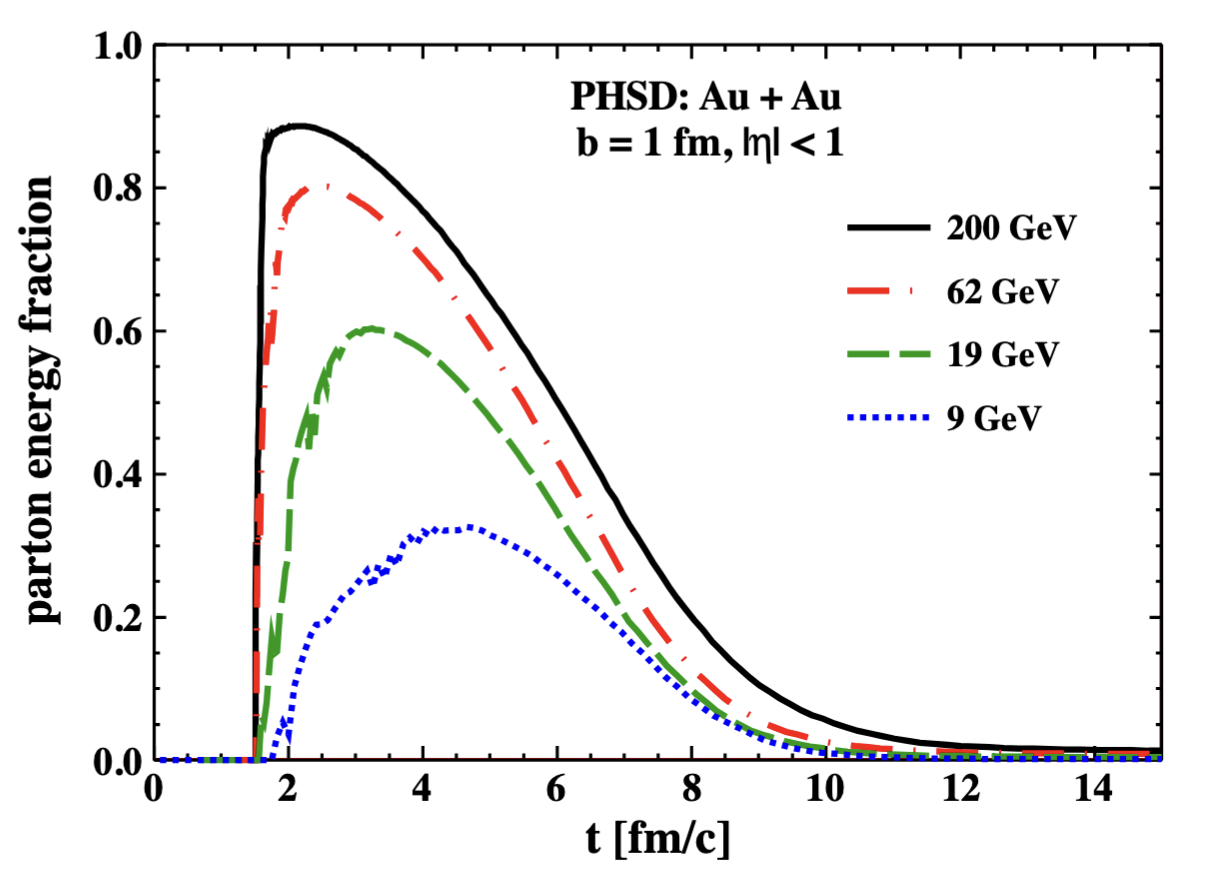
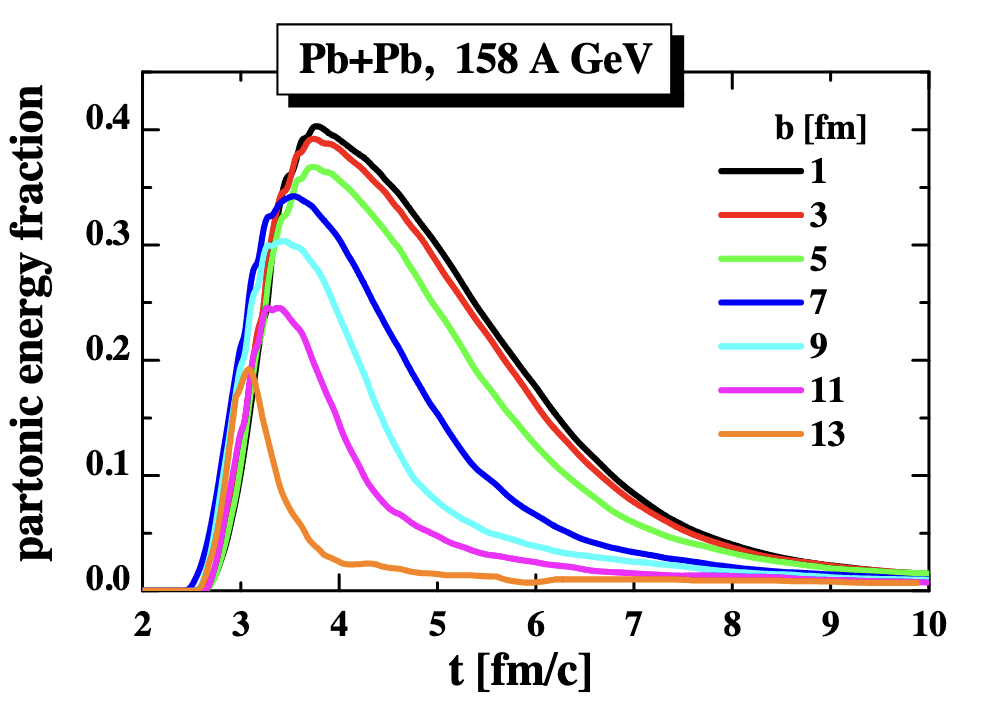
partonic energy fraction with time

Exploring the partonic phase at finite chemical potential within an extended off-shell transport approach

P. Moreau, O. Soloveva, L. Oliva, T. Song, W. Cassing, E. Bratkovskaya · Phys. Rev. C (2019) · arXiv:1903.10257

Show abstract

We extend the Parton-Hadron-String Dynamics (PHSD) transport approach in the partonic sector by explicitly calculating the total and differential partonic scattering cross sections as a function of temperature T and baryon chemical potential \mu_B on the basis of the effective propagators and couplings from the Dynamical QuasiParticle Model (DQPM) that is matched to reproduce the equation of state of the partonic system above the deconfinement temperature T_c from lattice QCD. The ratio of shear viscosity \eta over entropy density s, i.e. \eta/s, is evaluated using the collisional widths and compared to lQCD calculations for \mu_B = 0 as well. We find only a very modest change of \eta/s with the baryon chemical \mu_B. This also holds for a variety of hadronic observables from central A+A and C+Au collisions in the energy range 5 GeV \leq \sqrt{s_{NN}} \leq 200 GeV when implementing the differential cross sections into the PHSD approach. We only observe small differences in the strangeness and antibaryon sector with practically no sensitivity of rapidity and p_T distributions to the \mu_B dependence of the partonic cross sections. Since we find only small traces of a \mu_B-dependence in heavy-ion observables - although the effective partonic masses and widths as well as their partonic cross sections clearly depend on \mu_B - this implies that one needs a sizable partonic density and large space-time QGP volume to explore the dynamics in the partonic phase. These conditions are only fulfilled at high bombarding energies where \mu_B is, however, rather low. On the other hand, when decreasing the bombarding energy and thus increasing \mu_B, the hadronic phase becomes dominant and accordingly, it will be difficult to extract signals from the partonic dynamics based on "bulk" observables.

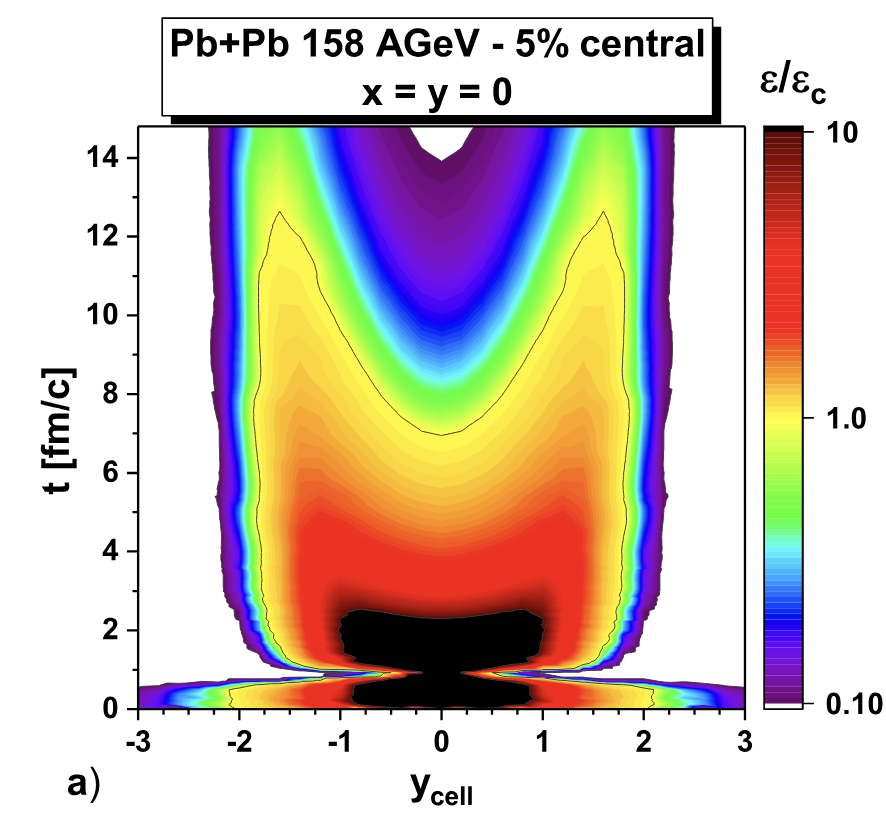
The energy density for central Pb+Pb collisions

Basic References To The PHSD Model

Core theoretical and phenomenological foundations.

From Kadanoff-Baym dynamics to off-shell parton transport

W. Cassing · Eur. Phys. J. ST 168 (2009) 3-87

Show abstract

This review provides a written version of lectures on non-equilibrium quantum field theory and shows the way from quantum-field theory in two-particle irreducible approximation to the Kadanoff-Baym equations and practical approximation schemes in phase space. This leads to an off-shell transport theory that incorporates the underlying quantum physics and can be solved in a testparticle representation for weak and strong coupling regimes. Applications to dilepton production in heavy-ion reactions and to hadronization from partonic to hadronic degrees of freedom are discussed.

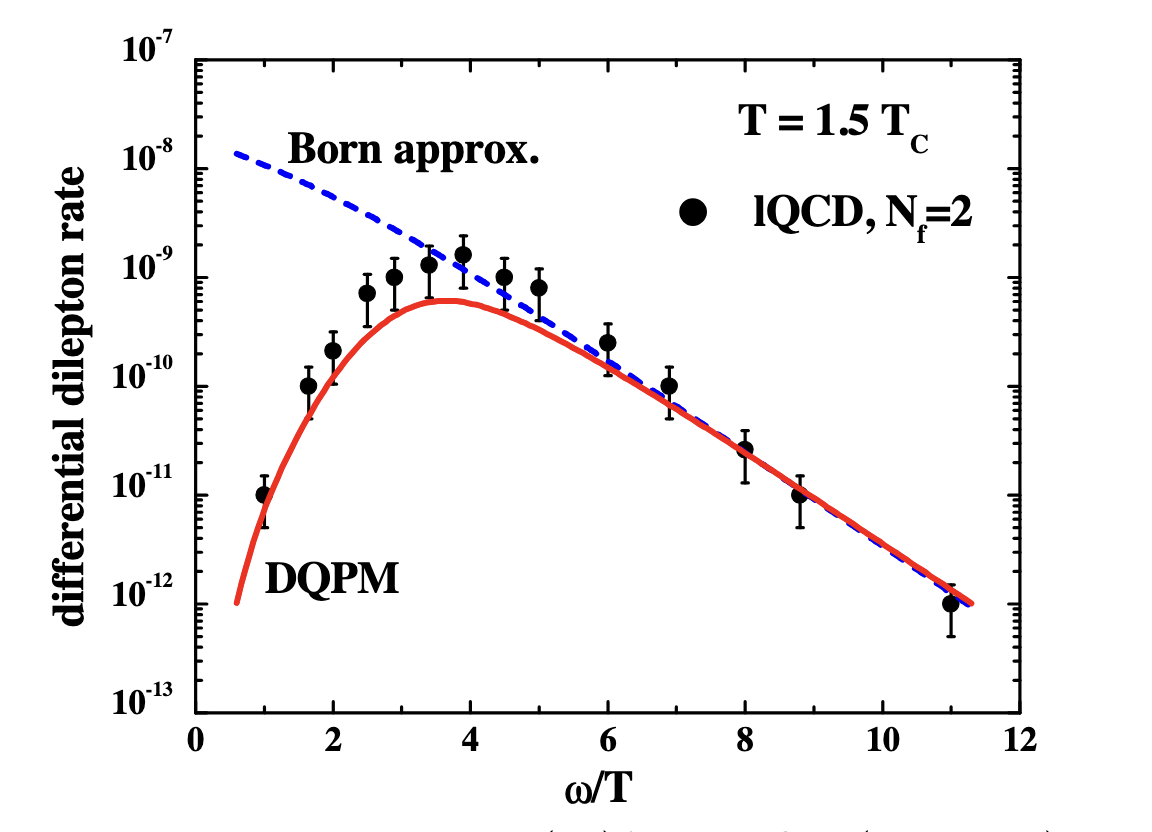
dilepton emission rate DQPM vs Born

Parton-Hadron-String Dynamics at relativistic collider energies

E. L. Bratkovskaya, W. Cassing, V. P. Konchakovski, O. Linnyk · Nucl. Phys. A 856 (2011) 162-182

Show abstract

The Parton-Hadron-String Dynamics (PHSD) transport approach is applied to nucleus-nucleus collisions at RHIC energies with respect to differential hadronic spectra in comparison to available data. PHSD is based on DQPM partons matched to lattice-QCD results and includes covariant transition rates for hadronization with all conservation laws. Dynamical studies for Au+Au collisions at top RHIC energy are compared to HSD results and to STAR, PHENIX, BRAHMS and PHOBOS data. The approach gives a reasonable description of rapidity distributions, transverse mass spectra and elliptic flow, and shows approximate quark-number scaling of v2 for hadrons.

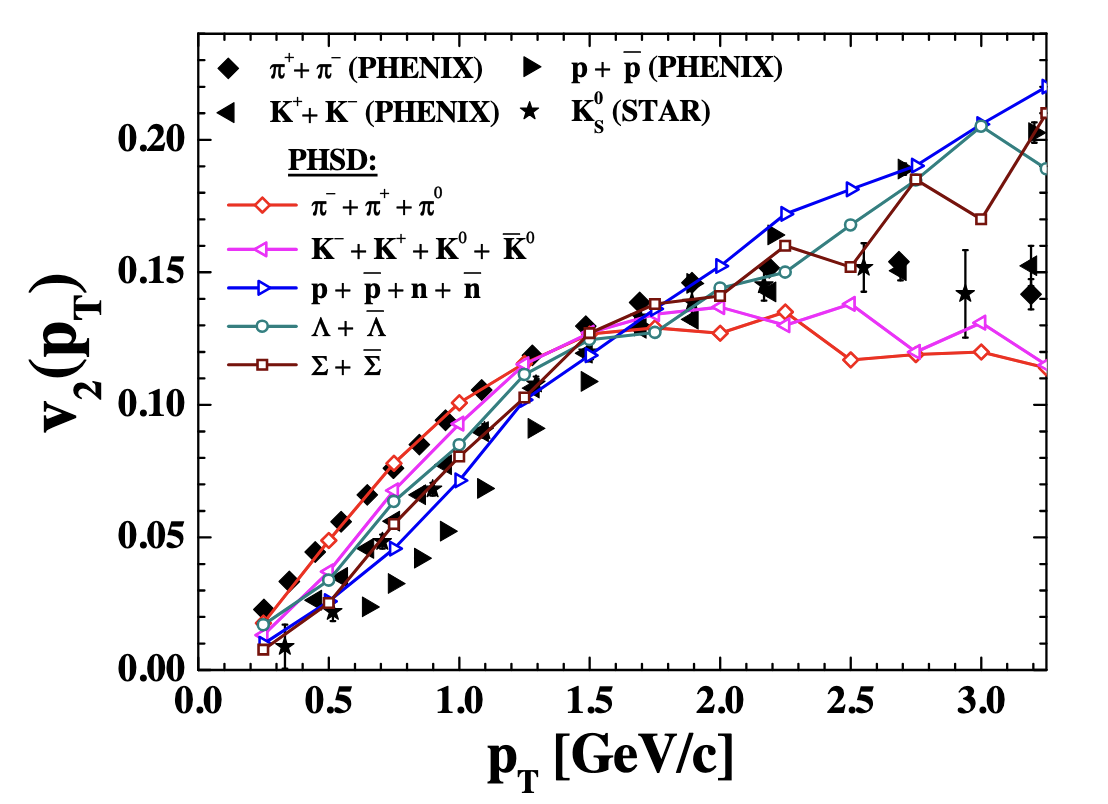
The hadron elliptic flow v2

Rise of azimuthal anisotropies as a signature of the Quark-Gluon Plasma in relativistic heavy-ion collisions

V. P. Konchakovski, E. L. Bratkovskaya, W. Cassing, V. D. Toneev, V. Voronyuk · Phys. Rev. C 85 (2012) 011902

Show abstract

The azimuthal anisotropies of collective transverse flow are investigated in a large range of heavy-ion collision energies within PHSD, which incorporates explicit partonic degrees of freedom as strongly interacting quasiparticles in line with a lattice-QCD equation of state, plus dynamical hadronization and hadronic final-state interactions. The experimentally observed increase of elliptic flow v2 with bombarding energy is reproduced, while higher harmonics v3 and v4 show growing deviations between partonic and purely hadronic models. This indicates that azimuthal anisotropies are sensitive probes of the underlying active degrees of freedom.

The evolution of the parton fraction of the total energy density.

Electromagnetic emission from strongly interacting hadronic and partonic matter created in heavy-ion collisions

A. W. Romero Jorge, T. Song, Q. Zhou, E. Bratkovskaya · Phys. Rev. C 111 (2025) 064904 · arXiv:2503.05253

Show abstract

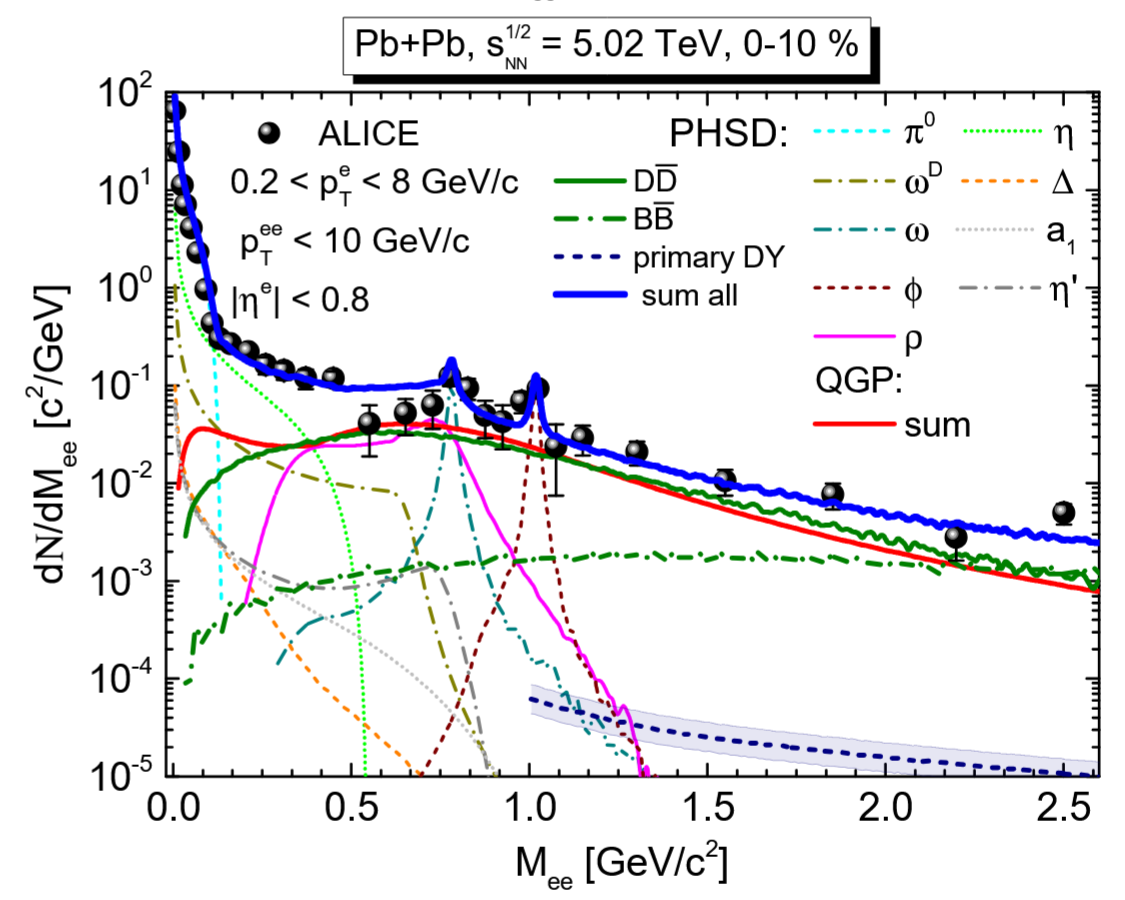
We investigate dilepton production in heavy-ion, proton-proton, and proton-nucleus collisions from low energies of 1 AGeV (SIS) to ultra-relativistic energies (LHC) using the Parton-Hadron-String Dynamics (PHSD) transport approach. PHSD is a microscopic, non-equilibrium approach that integrates hadronic and partonic degrees of freedom, providing a comprehensive description of relativistic heavy-ion collisions from initial nucleon-nucleon interactions to quark-gluon plasma (QGP) formation, hadronization, and final-state interactions. Key dilepton sources in PHSD include hadronic decays, bremsstrahlung, QGP radiation (q+\bar q \to e^+e^-, \ q+\bar q \to g+ e^+e^-, \ q+g \to q+ e^+e^-), primary Drell-Yan production, and semileptonic decays of correlated charm and bottom pairs. PHSD well describes dilepton data from HADES, STAR, and ALICE experiments. We examine in-medium effects, such as the vector meson spectral function broadening, and present the excitation function for the dilepton "excess" in the invariant mass range 0.4

Electromagnetic emission from strongly interacting hadronic and partonic matter created in heavy-ion collisions
Invariant mass spectra for Pb+Pb

Other Publications