PHSD-PHQMD is a Fortran-based unified transport simulation
framework for relativistic nucleus-nucleus collisions. It combines two
complementary descriptions of baryon dynamics:
PHSD, based on mean-field BUU transport, and
PHQMD, which follows a
Quantum Molecular Dynamics (QMD) n-body approach.
In both modes, the subsequent evolution includes quarks, gluons, mesons,
and hadrons propagated within a nonequilibrium
Kadanoff-Baym and BUU dynamics.
Interactions are treated through a collision integral for off-shell hadrons
and QGP partons, realized within the
Dynamical QuasiParticle Model (DQPM), which describes the
partonic medium consistently with lattice-QCD thermodynamics.
Final-state nuclear fragments and formed clusters can be reconstructed using
MST (Minimum Spanning Tree),
SACA (Simulated Annealing Cluster Algorithm),
or coalescence-based algorithms. Simulated events can be
exported in OSCAR, ROOT, and
Rivet formats.
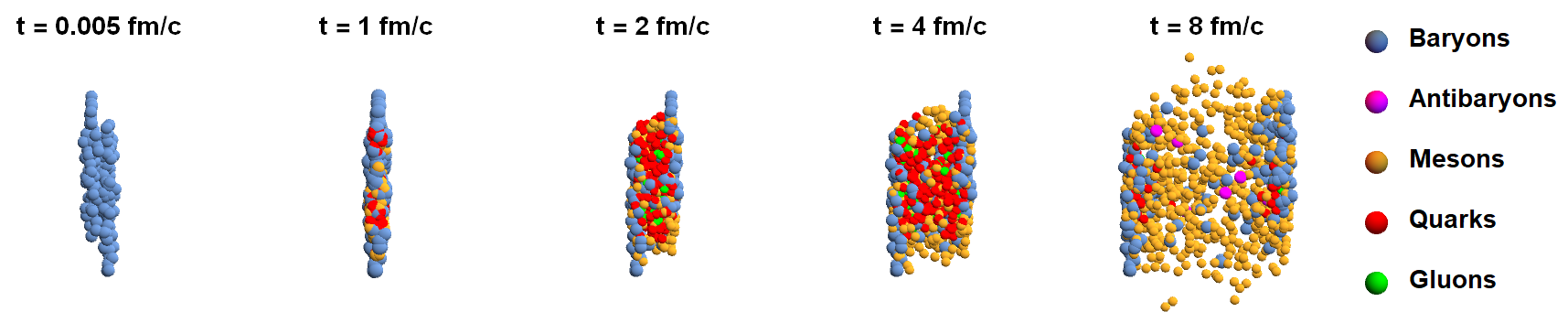
The Parton-Hadron-String Dynamics (PHSD) is a microscopic
off-shell transport approach that consistently describes the full evolution
of a relativistic heavy-ion collision from the initial hard scatterings and
string formation through the dynamical deconfinement phase transition to the
quark-gluon plasma, as well as hadronization and the subsequent interactions
in the hadronic phase. It has been developed by the Giessen/Frankfurt groups
on the basis of the Hadron-String Dynamics transport approach (HSD),
and in the hadronic sector PHSD is equivalent to HSD.
In PHSD, the transition from the partonic (quarks and gluons)
to hadronic degrees of freedom is described by covariant transition rates for
the fusion of quark-antiquark pairs to mesonic resonances or three quarks
(antiquarks) to baryonic states. This dynamical hadronization obeys flavor
current conservation, color neutrality, and energy-momentum conservation.
Two-particle correlations from finite parton spectral widths are treated
dynamically by generalized off-shell transport equations
that go beyond mean-field or Boltzmann approximations.
The transport-theoretical description of quarks and gluons in
PHSD is based on the
Dynamical Quasi-Particle Model (DQPM), constructed to
reproduce lattice-QCD results for a quark-gluon plasma in thermodynamic
equilibrium. The DQPM supplies mean fields for gluons
and quarks, as well as effective two-body interactions implemented in
PHSD. Close to the phase transition, dynamical quarks
and antiquarks become massive, such that resonant pre-hadronic color-dipole
states (q-qbar and qqq) are formed at large invariant mass
and then decay sequentially to the meson and baryon octets. The resulting
hadronization process increases total entropy and remains consistent with
the second law of thermodynamics.
The PHSD approach has been applied to nucleus-nucleus
collisions from low SPS to LHC energies to explore the space-time regions
of partonic matter. It provides a consistent description of bulk observables
in heavy-ion collisions, including rapidity spectra, transverse-mass
distributions, and azimuthal asymmetries (v1,
v2, v3, v4)
for multiple particle species, and has also been used successfully for
dilepton production analyses from hadronic and partonic sources at SPS,
RHIC, and LHC energies.
Equilibrium properties of the QGP have also been studied with
PHSD simulations in a finite box with periodic boundary
conditions at fixed temperature T. In particular, the shear-viscosity
to entropy-density ratio from PHSD shows a minimum of about
0.1 near the critical temperature
Tc = 160 MeV and approaches the perturbative-QCD limit
at higher temperatures, in line with lattice-QCD results. This supports a
strongly interacting liquid-like QGP (sQGP) rather than a weakly interacting
gas of partons.
The Parton-Hadron-Quantum-Molecular Dynamics (PHQMD)
transport approach is designed to provide a microscopic description of
nuclear cluster and hypernucleus formation, as well as general particle
production, in heavy-ion reactions at relativistic energies.
In contrast to coalescence or statistical models often used for cluster
formation, PHQMD forms clusters dynamically through
interactions between baryons described within
Quantum Molecular Dynamics (QMD), allowing the propagation
of the n-body Wigner density and n-body phase-space correlations that are
essential for cluster formation.
Clusters in PHQMD can be reconstructed using
MST, SACA, or coalescence-based algorithms.
At the same time, collisions among hadrons, quark-gluon-plasma formation,
and parton dynamics are treated in the same way as in the established
PHSD approach, making PHSD-PHQMD a consistent unified
framework for both bulk particle production and cluster observables.
 Explore DQPM