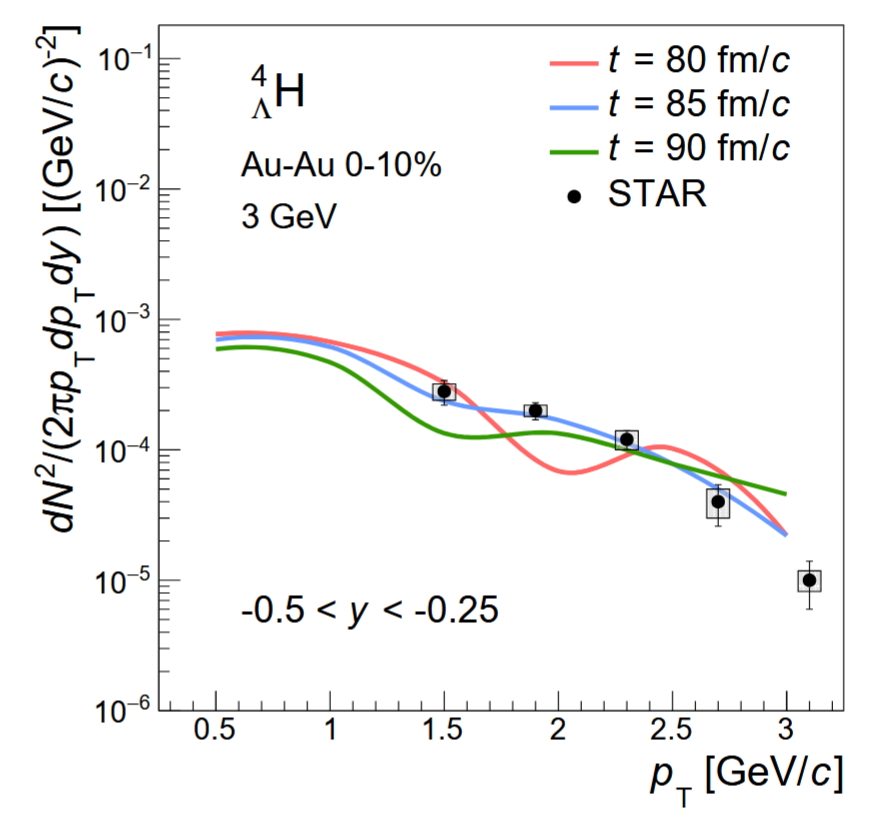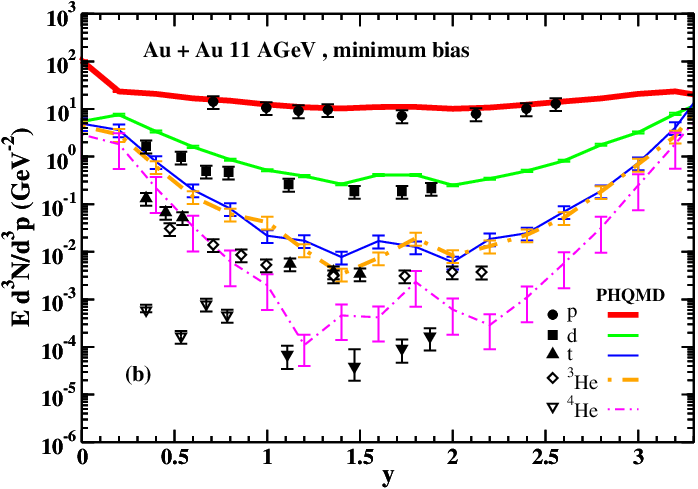

The Parton-Hadron-Quantum-Molecular Dynamics (PHQMD) transport approach is an n-body microscopic framework designed to describe nuclear cluster and hypernucleus formation, as well as general particle production, in relativistic heavy-ion reactions.
PHQMD combines baryon propagation from the Quantum Molecular Dynamics (QMD) model with the dynamical properties and interactions of hadronic and partonic degrees of freedom from the Parton-Hadron-String Dynamics (PHSD) approach.
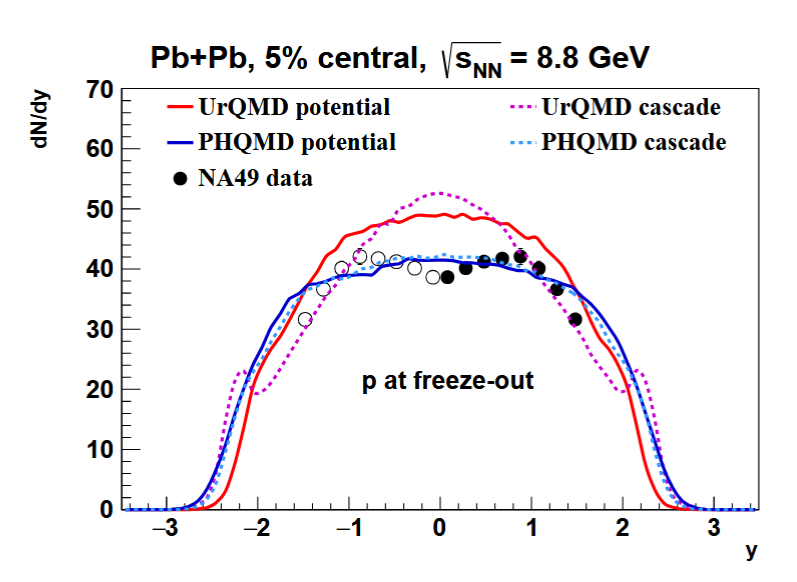
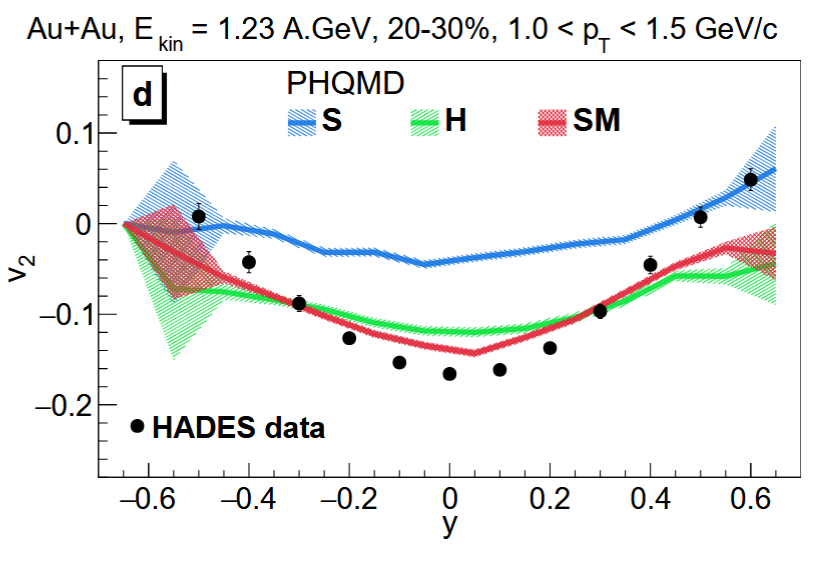
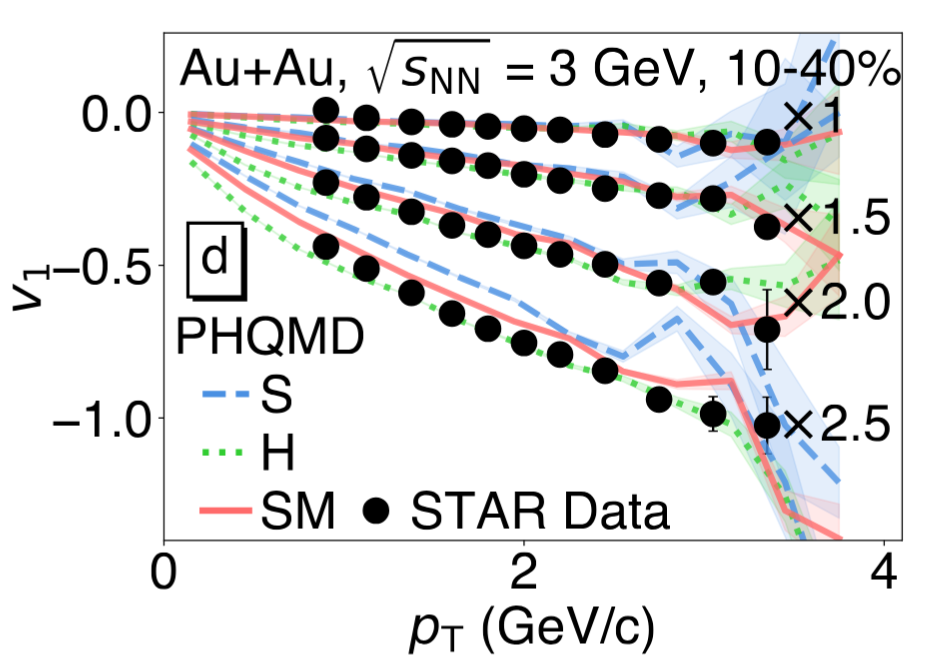
A recent development in PHQMD is the inclusion of a momentum-dependent nucleon potential in addition to the static, density-dependent Skyrme interaction. This extension enables three distinct equation-of-state (EoS) scenarios: two static cases (“soft” and “hard”), which differ in compressibility, and a soft momentum-dependent EoS calibrated to pA elastic scattering data.
Cluster Production in PHQMD
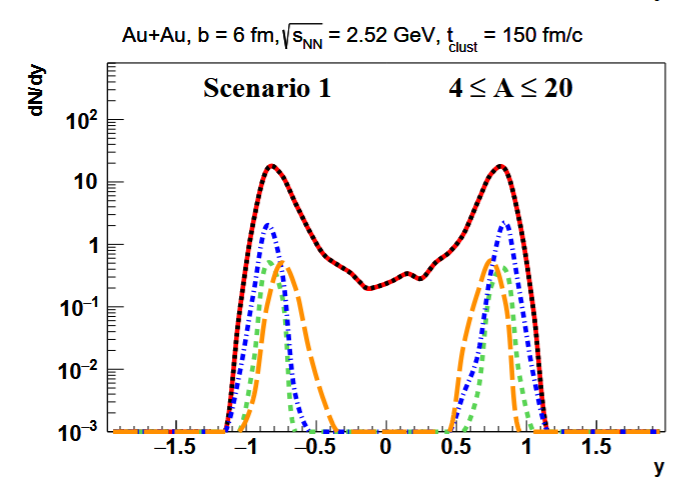
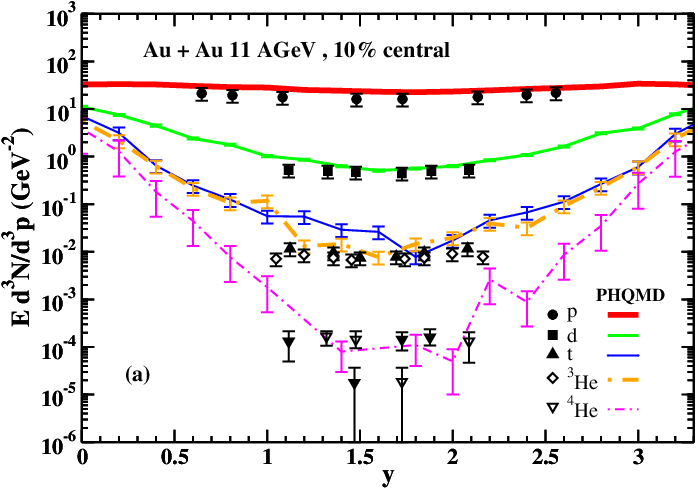
In contrast to coalescence or statistical approaches, PHQMD forms clusters dynamically through baryon interactions described within QMD. This allows the propagation of the n-body Wigner density and n-body phase-space correlations, which are essential for cluster formation.
Clusters can be identified in PHQMD using three different algorithms:
-
Potential mechanism:
The attractive potential between baryons with small relative momentum can keep
them close together and lead to bound groups of nucleons. These co-moving
nucleons can be identified during the dynamical evolution using the advanced
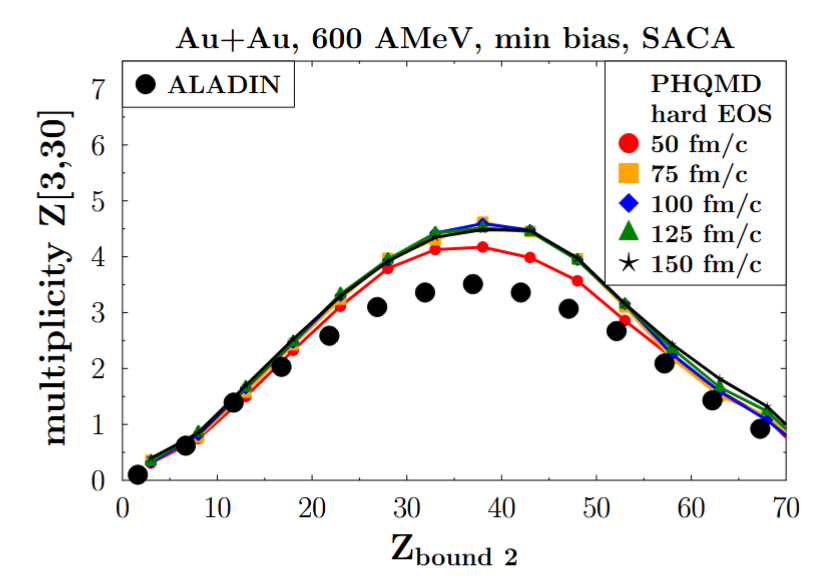
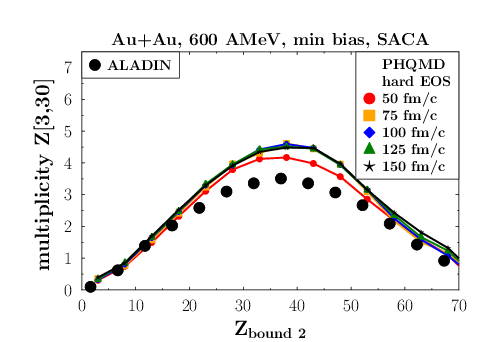
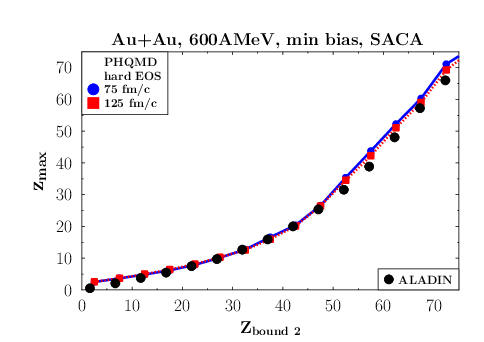
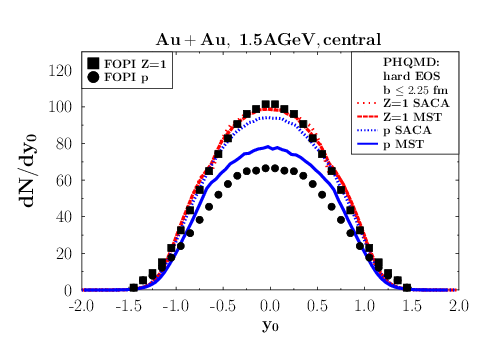
Minimum Spanning Tree (aMST) method or the SACA (Simulated Annealing Cluster
Algorithm), which searches for the most bound configuration of nucleons and
hyperons.
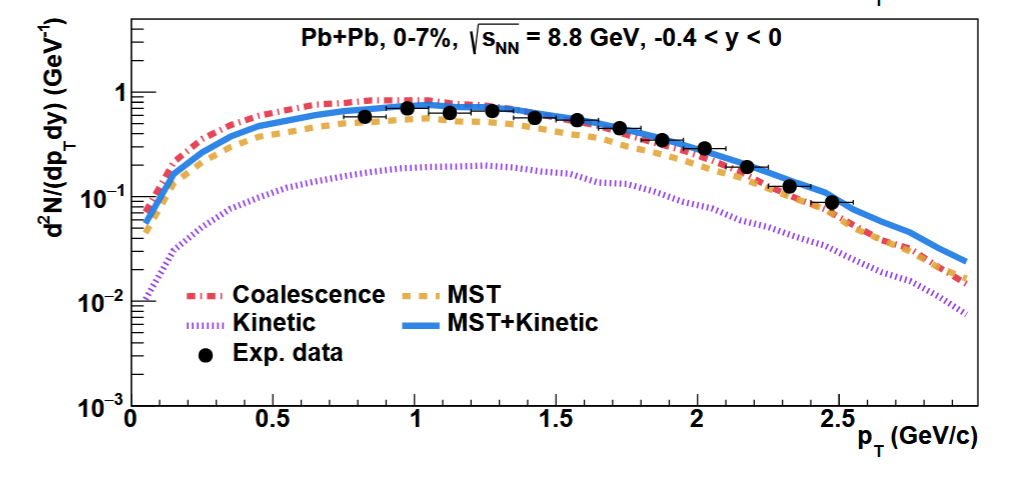
In the MST algorithm, two nucleons i and j are considered bound if|ri* - rj*| < rclus, where the positions are evaluated in the center-of-mass frame of the pair andrclus = 4 fm, roughly corresponding to the range of the attractive NN potential. In addition, aMST requires a negative binding energy,EB < 0, and includes a stabilization procedure to prevent the spontaneous decay of clusters caused by the semiclassical treatment. It should be noted that (a)MST acts as a cluster recognition tool, applied perturbatively, rather than as the actual formation mechanism, since QMD propagates baryons and not pre-formed clusters. -
Kinetic mechanism:
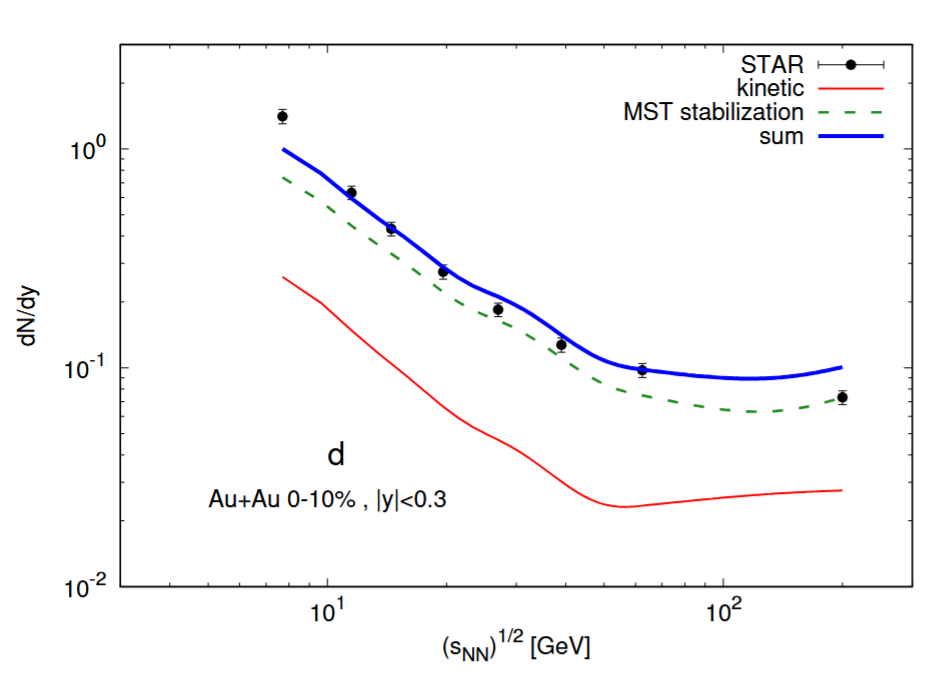
Deuterons are produced through catalytic hadronic reactions
πNN ↔ πdandNNN ↔ Ndin different isospin channels. Quantum effects are incorporated through excluded-volume corrections and projection onto the deuteron wave function in momentum space, which reduces the production probability, especially at target and projectile rapidities. -
Coalescence mechanism:
A proton and neutron form a deuteron if their phase-space distance at
freeze-out satisfies
|r1 - r2| ≤ 3.575 fmand|p1 - p2| ≤ 285 MeV/c. In PHQMD, this perturbative method is used only for model studies and comparison purposes.